
Can an Ohio employer with one employee get group health insurance? In some circumstances, yes.
One employee group health insurance in Ohio isn’t available through every type of arrangement, but one of the smallest groups we work with recently received its first renewal.
They have one employee.
Before establishing this plan, the organization had never offered group health insurance. They had an employee they wanted to insure, though, and they were willing to go through the process necessary to make it happen.
That process wasn’t insignificant.
We first had to determine what options were realistically available. The employer went through a health insurance prescreen. The employee completed the information necessary for underwriting. We evaluated the available plans and benefits. The organization completed the required membership process.
Then we had to answer a question every employer faces when offering health insurance for the first time:
Which plan do you actually choose?
Starting From Scratch Is Harder Than Renewing a Plan
At renewal, you at least have something to compare.
You know what the current deductible is. You know what the premium costs. You know how the employee feels about the coverage.
A new group doesn’t have any of that.
There may be dozens of plan designs with different deductibles, coinsurance levels, copays and out-of-pocket maximums.
Eventually, this employer selected a PPO plan with a $2,500 individual deductible.
After the deductible, covered major medical expenses were paid at 100% in-network. The individual out-of-pocket maximum was $7,000. Primary care and specialist visits had $30 and $60 copays, along with separate prescription copays.
It was a solid benefit package.
Then they spent the next year covered under it.
Then the First Renewal Arrived
The renewal increase was 7.51%.
The employee’s monthly premium increased from approximately $595 to $639.
Nobody enjoys a 7.51% health insurance increase, but renewals don’t exist in isolation.
For context, Peterson-KFF’s August 2026 analysis of proposed 2027 ACA-compliant small-group rates found a median proposed increase of approximately 14% nationally. Insurers in those filings were estimating underlying medical cost trend at a median of 10.8%. Individual ACA Marketplace insurers are proposing a median increase of approximately 15% for 2027.
Those aren’t direct comparisons to this particular MEWA renewal, and this group’s renewal occurs before the 2027 plan year.
But they do help put a 7.51% increase into perspective.
This was a pretty good renewal.
A Good Renewal Still Deserves a Review
It would have been easy to stop there.
The renewal wasn’t alarming. The plan was working. There was only one employee.
Renew it and move on.
But that’s not really a renewal review.
When I went through the available alternatives, one plan in particular caught my attention.
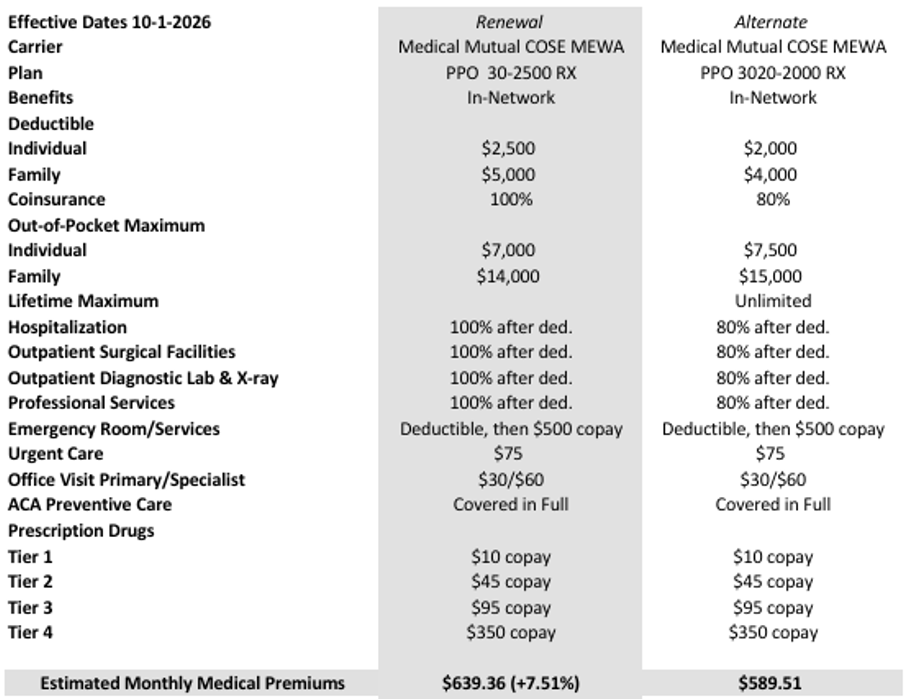
Its monthly premium was approximately $590, almost $50 per month below the renewal premium and actually a few dollars below what the employer had been paying during the previous year.
There was a tradeoff.
The alternative plan had a lower $2,000 deductible, but after meeting the deductible the plan paid 80% rather than 100%. Its individual out-of-pocket maximum increased from $7,000 to $7,500.
The office visit and prescription copays remained essentially the same.
This is also a useful reminder that you can’t judge a health plan simply by looking at the deductible.
Although the deductible is lower, the 80% coinsurance and slightly higher out-of-pocket maximum create greater potential cost exposure for the employee.
In exchange for that greater potential out-of-pocket exposure, the premium drops by roughly $600 per year.
That’s a real option.
Whether it’s worth making the change is another question.
My suspicion is that this employer may simply renew the existing plan.
And that would be perfectly reasonable.
The purpose of reviewing a renewal isn’t to manufacture a change. Sometimes the review confirms that what you already have remains the best place to be.
What This One-Employee Group Actually Built
There’s another part of this case that I think is easy to miss.
This employer didn’t simply buy health insurance for one employee.
They established a functioning group health insurance arrangement.
The COSE Benefit Plan is a multiple employer welfare arrangement administered by Medical Mutual. At the time of publication, the COSE Benefit Plan is available to qualifying Ohio businesses with one to 50 employees. Employers must meet applicable eligibility and underwriting requirements and participate through COSE or an affiliated chamber.
That meant more work at the beginning.
But now the structure exists.
If the organization eventually hires additional eligible employees, it isn’t starting the health insurance conversation from zero again. Subject to the plan’s rules and eligibility requirements, it already has an established group arrangement into which future employees may be enrolled.
That matters.
A business doesn’t suddenly have to figure out group health insurance for the first time when employee number two, five or ten arrives.
The foundation is already there.
Not Every One-Employee Employer Should Do This
I wouldn’t take this case to mean every business with one employee should immediately establish a group health plan.
Sometimes individual coverage makes more sense.
Sometimes an ICHRA may be worth considering.
Sometimes the economics simply don’t justify creating an employer-sponsored plan.
That’s why we evaluate the alternatives first.
But this employer had a reason to provide a meaningful benefit to an important employee. They explored their options, completed the underwriting process, joined the required organization, evaluated the plans and went through enrollment.
They went the distance.
A year later, the result is a good health plan, a relatively manageable first renewal and an established group health insurance arrangement capable of growing with them.
For one employee, that’s a pretty substantial accomplishment.
Sometimes being a very small employer doesn’t mean you need to duct-tape together a temporary solution. With the right circumstances and the willingness to do the work, you can build the real thing.
Client-identifying details have been omitted or generalized. Premiums have been rounded. Plan availability, eligibility, underwriting, benefits and rates vary by employer and are subject to current carrier and program requirements.
About the Author
For more than three decades, Ted Stevenot has helped Ohio small businesses and their owners evaluate health insurance and employee benefits as a partner at McCarthy Stevenot Agency, Inc.
He writes the Broker’s Desk series to document the real-world decisions, conversations, and observations that come from helping small businesses navigate health insurance.
Talk With McCarthy Stevenot Agency
If your Ohio business has only a few employees and you are trying to determine whether group health insurance is available and practical, we can help you evaluate the realistic options and understand the trade-offs.
For some employers, that may include comparing traditional small-group coverage, MEWA options, an ICHRA or other approaches. If underwriting-sensitive options may be available, a health insurance prescreen can also help determine what is realistic before making a decision.
Contact McCarthy Stevenot Agency to discuss your situation, or call 513-891-9888.
Related Resources
- Health Insurance for 5 or Fewer Employees in Ohio
- Ohio MEWA Health Plans for Small Businesses: A Practical Guide
- Health Insurance Prescreen for Ohio Small Businesses
- ICHRA for Ohio Employers
- Why Small Businesses Should Build a Health Insurance Renewal System
Disclaimer
Broker’s Desk is a series of observations from more than three decades of helping Ohio small businesses and their owners navigate health insurance. Some articles explain a process. Others tell the stories behind the work. Client-identifying details may be omitted or generalized to protect privacy. Plan availability, eligibility, underwriting, benefits and rates vary by employer and program. These articles are intended to help readers understand how experienced brokers think through real-world situations, not to suggest there is one right answer for every business or individual.