
Should Your Small Business Even Offer Group Health Insurance?

McCarthy Stevenot Agency street sign in Cincinnati, OhioA small-business owner calls and says, “We’re thinking about offering group health insurance.”

My first response is usually not to start talking about carriers, deductibles, or premiums.

It is more likely to be:

Are you sure you want to do that?

Should a small business offer group health insurance simply because it can?

Usually, no.

That may sound strange coming from a health insurance broker. But group health insurance is expensive. It requires ongoing administration. Premiums usually increase over time. Once employees begin relying on the benefit, it can also become difficult to take away.

Before a small employer begins offering coverage, there should be a real reason for doing it.

When Should a Small Business Offer Group Health Insurance?

The first question is not which plan to buy.

The first question is why the company is considering coverage now.

Sometimes the answer is compelling:

  • The company is growing and needs to hire more qualified employees.
  • A strong candidate will not accept the position without health benefits.
  • Existing employees are leaving for companies with stronger compensation packages.
  • A key employee or owner is losing other coverage.
  • The business has become financially stable enough to support an ongoing benefit.

Those are meaningful business reasons to consider a group plan.

Other times, the employer simply feels that offering health insurance is something a legitimate company is supposed to do.

That alone may not be enough.

Group Health Insurance Is a Significant Commitment

Employers sometimes think of group health insurance as a purchase. They select a plan, enroll the employees, and move on.

That is not how it works.

A group health plan creates continuing responsibilities:

  • The employer contributes toward employee premiums.
  • Employees are enrolled and removed as circumstances change.
  • New hires must be added within the required timeframes.
  • Eligibility and participation requirements must be managed.
  • Required notices and plan information must be provided.
  • The company must respond to annual renewals and cost increases.

Someone inside the company has to manage those responsibilities, even when the employer works with a broker or administrator.

The expense is also unlikely to remain fixed. Carriers change rates. Employees age. Claims experience may affect some arrangements. Provider networks and plan designs change.

Starting a group plan means accepting an ongoing management process, not making a one-time decision.

Sometimes Employees Already Have Workable Coverage

Consider a very small employer whose workers already have coverage through a spouse, a parent, Medicare, Medicaid, or the individual market.

The owner may be preparing to spend a substantial amount of money on a benefit that only one person truly needs.

If the company is not having trouble hiring, employees are not asking for coverage, and cash flow remains tight, the plan may not solve a significant business problem.

In that situation, I may recommend waiting.

That is not a permanent answer. The company can reconsider the decision when the workforce, finances, or hiring environment changes.

What Is the Cost of Not Offering Benefits?

Group health insurance becomes easier to justify when not having it is already creating a cost.

The company may be losing candidates. It may be struggling to retain experienced employees. An owner may be spending too much time replacing people who leave for stronger benefit packages.

At that point, the employer is no longer comparing the cost of a health plan with zero.

The employer is comparing it with the cost of turnover, missed hires, recruiting delays, lost productivity, and the inability to build the team the company needs.

This often becomes more important as a company grows and the type of employee it needs begins to change.

Some employers with a largely part-time workforce may face less immediate pressure to establish a traditional group plan. A company competing for experienced managers, engineers, salespeople, technicians, or other skilled employees may reach the decision much sooner.

A strong candidate may already have employer-sponsored coverage and see no reason to give it up.

In that situation, health insurance is not simply another expense. It may be part of what allows the company to continue growing.

Starting Later Can Be Better Than Starting Too Early

There is no prize for beginning a group health plan before the company is ready.

A new or very small business may benefit from preserving cash and flexibility for as long as reasonably possible.

Starting later may allow the employer to:

  • Build more predictable revenue.
  • Understand what employees actually need.
  • Reach a more workable participation level.
  • Develop a sustainable contribution strategy.
  • Introduce the benefit when it supports a clear employment objective.

The goal should not be to postpone coverage indefinitely. It should be to begin when the benefit solves a real problem and the company can reasonably support it.

When It Does Make Sense, Sustainability Matters

Once an employer has a compelling reason to offer coverage, the next question is how to structure it responsibly.

The richest available plan is not necessarily the right plan.

The company should consider:

  • How much it can contribute each month.
  • How many employees are likely to enroll.
  • Whether employees have other coverage available.
  • Which provider networks fit the workforce.
  • How much renewal volatility the company can tolerate.
  • Whether traditional group coverage or an individual coverage approach is more appropriate.

Ohio employers may have access to ACA small-group plans, MEWAs, level-funded arrangements, and, in some situations, an Individual Coverage Health Reimbursement Arrangement.

The objective is not to find a perfect plan that will never change. It is to establish a benefit the company can manage and review over time.

A Broker Should Be Willing to Say Not Yet

Insurance brokers are generally compensated when coverage is placed. That can make it easy to treat every inquiry as an opportunity to begin quoting plans.

But sometimes the most useful advice is that the employer should wait.

If the company has uncertain cash flow, little hiring pressure, low employee interest, and workable alternatives already in place, starting a group plan may create more burden than value.

When the facts change, the recommendation may change too.

A company that begins growing rapidly, needs to recruit more qualified employees, or starts losing people because it lacks benefits may reach a very different conclusion.

The right question is not whether group health insurance is generally good. It is when a small business should offer group health insurance and whether this company is ready for it.

It is whether offering it makes sense for this employer, with this workforce, at this point in the company’s development.

About the Author

For more than three decades, Ted Stevenot has helped Ohio small businesses evaluate employee benefits as a partner at McCarthy Stevenot Agency, Inc.

He writes the Broker’s Desk series to document the real-world decisions, conversations, and observations that come from helping Ohio employers navigate health insurance renewals and employee benefits.

Talk With McCarthy Stevenot Agency

If your Ohio small business is considering offering health insurance, the first step is understanding what you are trying to accomplish and whether the company is ready for the commitment.

Contact McCarthy Stevenot Agency to discuss the group and determine which review process makes sense, or call 513-891-9888.

Related Resources

Disclaimer

Broker’s Desk is a series of observations from more than three decades of helping Ohio employers navigate health insurance. Some articles explain a process. Others tell the stories behind the work. All are intended to help employers understand how experienced brokers think through real-world situations, not to suggest there is one right answer for every employer.

Sometimes the Problem Isn’t the Claim

Blue and white street sign for McCarthy Stevenot Agency, Inc. in Milford, OH

Choosing a small business health insurance broker in Ohio - McCarthy Stevenot Agency, Inc street signWhen an employer hears there may be a problem with a health insurance claim, it’s natural to assume the insurance company has denied coverage.

Sometimes that’s true.

Sometimes the problem isn’t the claim at all.

Recently, a client contacted us after their healthcare provider indicated there could be a problem obtaining authorization for a scheduled surgery. The explanation centered on the group’s health plan showing an August 31 coverage end date.

That immediately raised more questions than it answered.

Questions about claim authorization can sometimes stem from coverage issues, eligibility information, renewal timing, or simple administrative confusion. The first step is figuring out which one you’re actually dealing with.

Small business health plans renew throughout the year. An upcoming renewal date, by itself, shouldn’t explain why a scheduled procedure suddenly appears to have a problem.

Rather than jumping to conclusions, we started asking a different question:

What are we missing?

At a Glance

  • Not every authorization issue is a coverage issue.
  • Administrative problems can create confusing signals.
  • Experience helps identify where the real problem lies.
  • Resolving the underlying issue often allows the claim process to move forward.

When the Pieces Don’t Fit Together

As we looked deeper, the pieces didn’t seem to fit together.

The renewal hadn’t arrived through the normal process. When renewal information finally became available, it didn’t resemble a typical renewal. Instead of clearly showing the current plan renewing into the next plan year, the documents looked more like alternate proposals. At the same time, different people were receiving different information about the group’s eligibility and renewal status.

None of those things, by themselves, meant the surgery wouldn’t be covered.

Together, though, they suggested the claim itself wasn’t the real issue. Something in the administrative process wasn’t lining up, and we needed to untangle that first.

Experience Means Knowing Where to Look

Experience isn’t just knowing the rules. It’s recognizing when the facts don’t fit the explanation.

After decades of working with small group health plans, you develop a sense for what looks normal and what doesn’t. Sometimes the most valuable thing a broker brings isn’t an immediate answer. It’s knowing where to look next.

In this case, that meant making additional calls, confirming the group’s renewal status, and working through the questions until the situation became clear.

Once the renewal information was confirmed, the concern that had been delaying the authorization process was resolved, and everything could continue through the normal channels.

From the client’s perspective, it looked like a surgery might not happen because of an insurance problem.

From our perspective, it looked like several administrative pieces weren’t lining up yet.

Those are two very different things.

What Clients Never See

Most employers never see that part of the process. They don’t see the questions being asked behind the scenes, the unusual renewal paperwork, or the phone calls needed to separate an administrative issue from an actual coverage issue.

They simply hear back that the situation has been sorted out.

In this case, resolving the administrative issue removed the obstacle preventing the authorization process from moving forward.

That’s exactly the outcome we hope for.

Because sometimes the most important work happens before a claim is ever denied.

Sometimes the problem isn’t the claim in the first place.

About the Author

For more than three decades, Ted Stevenot has helped Ohio small businesses evaluate employee benefits as a partner at McCarthy Stevenot Agency, Inc.

He writes the Broker’s Desk series to document the real-world decisions, conversations, and observations that come from helping Ohio employers navigate health insurance renewals and employee benefits.

Protecting Client Privacy

Client names, identifying details, and certain facts have been modified or omitted to protect client confidentiality. The situations described reflect real-world experience, but no post is intended to identify a specific employer.

Looking for a deeper explanation of the renewal process? These guides provide additional context.

Related Resources

Disclaimer

Broker’s Desk is a series of observations from more than three decades of helping Ohio employers navigate health insurance. Some articles explain a process. Others tell the stories behind the work. All are intended to help employers understand how experienced brokers think through real-world situations—not to suggest there is one right answer for every employer.


Why Even a Good Renewal Still Takes Careful Review

Blue and white street sign for McCarthy Stevenot Agency, Inc. in Milford, OH

Blue and white street sign for McCarthy Stevenot Agency, Inc. in Milford, OHOne of our recent small business health insurance renewals really stood out.

Every client has an expected renewal timeline. As those dates approach, we’re watching for renewal information so we have time to review it before decisions are made.

Based on our renewal calendar, this one should have arrived.

It hadn’t.

That simple observation started everything that followed.

So we contacted the carrier and learned this renewal had fallen outside the normal process and required additional handling. After a little persistence, it finally arrived.

I thought we were ready to begin the review.

We weren’t.

First, We Had to Figure Out What We Were Reviewing

The renewal packet contained several proposal pages, but it never clearly identified which plan the group was actually being renewed into.

It also didn’t include the Summary of Benefits and Coverage (SBC) for that plan.

Before I could compare premiums or benefits, I first had to know exactly what I was comparing.

We contacted the carrier again, confirmed the renewal plan, and requested the SBC.

Only then could the review really begin.

Evaluating the Small Business Health Insurance Renewal

Because the employee census had changed, the first step was recalculating last year’s premium using the current enrollment. That gave us an apples-to-apples comparison.

The result was an true increase of approximately 5.2%.

From there, we compared the benefits.

Almost everything remained the same. The primary change was that emergency room services moved from 100% after the deductible to a $300 emergency room copay plus the deductible, followed by 100% coverage.

For a renewal in that range, it was a relatively modest change.

Could We Do Better?

We still looked at the alternatives.

One thing employers don’t always see is that plan options aren’t always available in small, predictable steps.

The next comparable non-HSA copay plan wasn’t just a slightly higher deductible. It jumped from a $5,000 deductible with 100% coverage after the deductible to a $6,000 deductible with 80% coverage after the deductible.

Yes, it lowered the premium.

It also represented a much bigger change in benefits.

One thing I’ve learned over the years is that you work with the hand you’re dealt. I can’t invent plan options that don’t exist. My job is to understand the options that are available and recommend the least disruptive path for the client.

In this case, staying with the current plan made the most sense.

Broker’s Desk

Looking back, what stands out isn’t the 5.2% increase.

It’s everything that had to happen before we could confidently recommend accepting it.

Had the client opened that renewal packet on their own, I think they would have had more questions than answers. The renewal plan wasn’t clearly identified, the actual increase wasn’t obvious because the employee census had changed, and the benefit documents weren’t included.

That’s why even a good renewal deserves a careful review.

Sometimes the value isn’t finding a different plan.

Sometimes it’s simply bringing clarity to a process that would otherwise leave more questions than answers.

At a Glance

  • A scheduled renewal didn’t arrive when expected, prompting us to follow up with the carrier.
  • The renewal packet didn’t clearly identify the renewal plan or include the Summary of Benefits and Coverage (SBC).
  • We confirmed the correct renewal plan before comparing premiums and benefits.
  • After adjusting for changes in the employee census, the actual increase was approximately 5.2%.
  • The primary benefit change was a $300 emergency room copay plus the deductible.
  • We reviewed alternative plans, but the next comparable option required a much larger change in benefits.
  • The recommendation was to remain with the current plan because it represented the least disruptive path.

About the Author

For more than three decades, Ted Stevenot has helped Ohio small businesses evaluate employee benefits as a partner at McCarthy Stevenot Agency, Inc.

He writes the Broker’s Desk series to document the real-world decisions, conversations, and observations that come from helping Ohio employers navigate health insurance renewals and employee benefits.

Protecting Client Privacy

Client names, identifying details, and certain facts have been modified or omitted to protect client confidentiality. The situations described reflect real-world experience, but no post is intended to identify a specific employer.

If you’d like to learn more about health insurance renewals and employee benefits, these guides provide additional context.

Related Resources

Disclaimer

Broker’s Desk is a series of observations from more than three decades of helping Ohio employers navigate health insurance. Some articles explain a process. Others tell the stories behind the work. All are intended to help employers understand how experienced brokers think through real-world situations—not to suggest there is one right answer for every employer.

You Don’t Know Your Broker Until Something Goes Wrong

Blue and white street sign for McCarthy Stevenot Agency, Inc. in Milford, OH

McCarthy Stevenot Agency street sign in Cincinnati, OhioEvery health insurance broker says they provide great service.

The problem is, there’s no way to prove it in advance.

You can read Google reviews. You can ask for references. You can look at awards and credentials.

But you really don’t know.

Not until something goes wrong.

When a Health Insurance Broker Is Really Tested

One afternoon an employer called our office.

“Mike, I’ve got an employee here with me. We need to talk.”

The employee had just been diagnosed with cancer. Her doctor had recommended a treatment, but the insurance company had denied it.

She was scared.

She was frustrated.

She didn’t know what to do next.

Mike listened.

He told her we’d figure out exactly why it had been denied. If the insurance company was correct, we’d explain it. If there was an opportunity to appeal or ask for an exception, we’d pursue it.

Then he hung up the phone and went to work.

I’ve watched Mike do this for years.

He knows who to call. He knows how to explain the situation. He knows when to push, when to ask, and when not to accept the first answer.

Sometimes the decision changes.

Sometimes it doesn’t.

One thing always stays the same.

The client knows someone is standing beside them.

Years ago there was another case involving an infant who was ready to leave the hospital but needed approval for equipment to safely go home. The equipment cost very little compared to the hospital stay that continued while everyone waited for an answer.

Mike wouldn’t let it go.

He kept working the phones until someone finally looked at the situation as a whole instead of simply processing another request.

People ask us from time to time what makes our agency different.

Honestly, I don’t think it’s something you can explain with a list of services.

It’s this.

It’s what happens on the day a client calls with bad news.

I’ve often thought that’s the hardest part about talking about service.

Before someone becomes a client, it’s just a promise.

After thirty-five years, I know what happens when those difficult calls come in.

I’ve seen Mike answer them.

I’ve seen him advocate for people who needed someone in their corner.

And I’ve learned that real service isn’t measured by how smoothly things go when life is easy.

It’s measured by who stands beside you when life isn’t.

At a Glance

  • You often learn the value of your insurance broker when something unexpected happens.
  • Helping clients navigate difficult claim situations is part of the work behind employee benefits.
  • Advocacy can include understanding denials, asking questions, and pursuing available appeal options.
  • Some situations have positive outcomes, while others do not, but clients deserve clear guidance throughout the process.
  • Real service is measured by how people are supported when challenges arise.

About the Author

For more than three decades, Ted Stevenot has helped Ohio small businesses evaluate employee benefits as a partner at McCarthy Stevenot Agency, Inc.

He writes the Broker’s Desk series to document the real-world decisions, conversations, and observations that come from helping Ohio employers navigate health insurance renewals and employee benefits.

Protecting Client Privacy

Client names, identifying details, and certain facts have been modified or omitted to protect client confidentiality. The situations described reflect real-world experience, but no post is intended to identify a specific employer.

If you’d like to learn more about health insurance renewals and employee benefits, these guides provide additional context.

Related Resources

Disclaimer

Broker’s Desk is a series of observations from more than three decades of helping Ohio employers navigate health insurance. Some articles explain a process. Others tell the stories behind the work. All are intended to help employers understand how experienced brokers think through real-world situations—not to suggest there is one right answer for every employer.

What Happens Before We Ever Call About Your Renewal

Blue and white street sign for McCarthy Stevenot Agency, Inc. in Milford, OH

McCarthy Stevenot Agency street sign in Cincinnati, OhioMost employers never see the first part of their health insurance renewal.

They get an email from me with the renewal attached, a summary spreadsheet, and maybe a recommendation. What they don’t see is everything that happened before I clicked Send.

Here’s the thing.

By the time you see that email, I’ve probably been thinking about your renewal for days.

Every insurance company has its own way of delivering renewals. Some send an email. Some post them to a broker portal. Some are right on time. Some are late. Some years they’re early, and the next year they’re not. After all these years, I’ve learned not to expect too much consistency.

Around the turn of every month, I’m watching for them.

What I Look for First

When they start coming in, the very first thing I look at isn’t the premium.

It’s the percentage increase.

If I see a low single-digit renewal, I almost relax. That’s probably not going to be a difficult conversation.

When I see 18%, 27%, or 43%…

I still don’t like it.

That hasn’t changed in thirty-five years.

Mike McCarthy has a saying I’ve always liked.

“We hit the ceiling before the client does.”

It’s true.

Before we ever call the employer, we’ve already had our own reaction. We’ve already been frustrated. We’ve already started asking ourselves the same questions the client is going to ask.

  • Can we do better than this?
  • Can we reduce the increase?
  • Can we preserve the benefits employees are already comfortable using?

That’s where the real work begins.

The renewal goes into our system. I organize the files. I start building the summary spreadsheet. I begin looking through the carrier’s plan offerings for alternatives that make sense.

Not the cheapest plans.

The plans that are the least disruptive while still accomplishing something meaningful.

There’s a difference.

Eventually all of that becomes one simple email.

Your renewal.

A summary spreadsheet.

And a note that says if you’d like to review additional options, we’ll get started.

The email is only a few paragraphs long.

The work behind it has been going on long before it arrived in your inbox.

That’s the part most people never see.

At a Glance

  • Much of the work behind a health insurance renewal happens before the employer receives the renewal.
  • The first thing I evaluate is the percentage increase, not just the premium.
  • Every renewal is reviewed for opportunities to reduce costs while minimizing disruption.
  • The summary employers receive represents days of preparation and analysis.
  • The goal is to make a complicated renewal easier to understand and evaluate.

About the Author

For more than three decades, Ted Stevenot has helped Ohio small businesses evaluate employee benefits as a partner at McCarthy Stevenot Agency, Inc.

He writes the Broker’s Desk series to document the real-world decisions, conversations, and observations that come from helping Ohio employers navigate health insurance renewals and employee benefits.

Protecting Client Privacy

Client names, identifying details, and certain facts have been modified or omitted to protect client confidentiality. The situations described reflect real-world experience, but no post is intended to identify a specific employer.

If you’d like to explore the renewal process in more detail, these guides provide additional context.

Related Resources

Disclaimer

Broker’s Desk is a series of observations from more than three decades of helping Ohio employers navigate health insurance. Some articles explain a process. Others tell the stories behind the work. All are intended to help employers understand how experienced brokers think through real-world situations—not to suggest there is one right answer for every employer.

Pulling the Signal Out of the Noise

Blue and white street sign for McCarthy Stevenot Agency, Inc. in Milford, OH

McCarthy Stevenot Agency street sign in Cincinnati, OhioOne of the things people never see is the amount of noise inside a health insurance renewal.

Every carrier has its own proposal.

Every carrier has its own plans.

Every year those plans change.

Some carriers have dozens of options.

Honestly, most people have no chance.

That’s not because they aren’t smart. It’s because these proposals weren’t written for employers. These proposals weren’t written for employers. They were written by actuaries, product managers, and insurance companies trying to offer every possible variation of coverage.

Our job is to make sense of it.

Reducing Complexity in a Health Insurance Renewal

When a renewal comes in, I don’t just forward the proposal to the client.

I start pulling it apart.

I have a spreadsheet I’ve built over many years. Every time I come across a plan that’s actually relevant, I save it. Over time it’s become a library of plans that lets me compare things much more quickly.

I’m not trying to summarize everything.

I’m trying to surface the things employers actually care about.

  • The deductible.
  • The out-of-pocket maximum.
  • Office visit copays.
  • Prescription drug copays.
  • Coinsurance.

The proposal may be fifty pages.

My spreadsheet fits on one page.

That’s intentional.

I’m trying to pull the signal out of the noise.

The other thing I’m thinking about is disruption.

A lot of people assume the goal is to find the cheapest plan.

It isn’t.

If employees have spent years learning how to use a particular type of plan, I don’t want to throw that away just to save a little more money.

I’m looking for the point where the savings become meaningful without unnecessarily changing how people receive care.

Sometimes we find that point with the current carrier.

Sometimes we don’t.

That’s when we begin looking outside the renewal.

But the first step is always the same.

Reduce the complexity.

Then make the decision.

That’s a much better way to compare health insurance than trying to digest fifty pages of insurance language on your own.

At a Glance

  • Most health insurance renewals contain far more information than employers need to make a decision.
  • My first step is reducing dozens of pages into a simple comparison.
  • I focus on the plan details that affect employees most often.
  • The goal isn’t simply finding the lowest premium. It’s balancing savings with unnecessary disruption.
  • Simplifying the renewal makes better decisions possible.

About the Author

For more than three decades, Ted Stevenot has helped Ohio small businesses evaluate employee benefits as a partner at McCarthy Stevenot Agency, Inc.

He writes the Broker’s Desk series to document the real-world decisions, conversations, and observations that come from helping Ohio employers navigate health insurance renewals and employee benefits.

Protecting Client Privacy

Client names, identifying details, and certain facts have been modified or omitted to protect client confidentiality. The situations described reflect real-world experience, but no post is intended to identify a specific employer.

If you’d like to explore the renewal process in more detail, these guides provide additional context.

Related Resources

Disclaimer

Broker’s Desk is a series of observations from more than three decades of helping Ohio employers navigate health insurance. Some articles explain a process. Others tell the stories behind the work. All are intended to help employers understand how experienced brokers think through real-world situations—not to suggest there is one right answer for every employer.

The Renewal System You Didn’t Know You Had

Blue and white street sign for McCarthy Stevenot Agency, Inc. in Milford, OH

McCarthy Stevenot Agency street sign in Cincinnati, OhioEvery health insurance renewal follows a process, whether the employer realizes it or not.

When Mike McCarthy and I started our agency, we had a pretty simple idea.

We wanted to give small employers the kind of attention that large employers usually receive.

That idea has never really changed.

Whether a company has two employees or one hundred, the renewal goes through the same process.

  • We review it.
  • We build the summary spreadsheet.
  • We look for reasonable alternatives.
  • If it makes sense to shop the market, we open that door too.

The funny thing is, a lot of employers probably don’t even realize they have a renewal system.

They just know that every year a renewal email shows up, we explain what happened, and we help them decide what to do next.

Behind the scenes, though, it’s the same process every time.

Why We Built It This Way

I’ve talked with other brokers over the years who do things differently.

Some wait to see if the employer calls after receiving the renewal.

Some charge separately to review the market or evaluate additional options.

I understand why.

There’s real work involved.

We just made a different decision.

To me, reviewing the renewal and helping a client understand their options isn’t an extra service.

It’s the job.

I’ve known too many small business owners over the years.

A lot of them are working incredibly hard just to keep health insurance available for their employees. Some are hanging on by their fingernails.

I’ve never been very excited about sending them another invoice just so we can help them evaluate their renewal.

I’d rather spend my time helping them make a good decision.

Maybe that’s a little old-fashioned.

It’s just how we’ve always believed this business should work.

When we talk about service, we’re not just talking about being friendly or returning phone calls quickly.

Those things matter.

But real service is having a system that’s there for every client, every renewal, every year.

Whether the group has two employees or one hundred.

That’s the promise we made when we started the agency.

It’s still the one we’re trying to keep.

At a Glance

  • Every renewal receives the same review process.
  • Small employers receive the same attention as larger groups.
  • We don’t view renewal analysis as an extra service.
  • Our goal is to help employers make informed decisions.
  • Service begins long before the phone rings.

About the Author

For more than three decades, Ted Stevenot has helped Ohio small businesses evaluate employee benefits as a partner at McCarthy Stevenot Agency, Inc.

He writes the Broker’s Desk series to document the real-world decisions, conversations, and observations that come from helping Ohio employers navigate health insurance renewals and employee benefits.

Protecting Client Privacy

Client names, identifying details, and certain facts have been modified or omitted to protect client confidentiality. The situations described reflect real-world experience, but no post is intended to identify a specific employer.

Looking for a deeper explanation of the renewal process? These guides provide additional context.

Related Resources

Disclaimer

Broker’s Desk is a series of observations from more than three decades of helping Ohio employers navigate health insurance. Some articles explain a process. Others tell the stories behind the work. All are intended to help employers understand how experienced brokers think through real-world situations—not to suggest there is one right answer for every employer.

A 28% Renewal Didn’t Send Us Looking for Another Carrier

Blue and white street sign for McCarthy Stevenot Agency, Inc. in Milford, OH

McCarthy Stevenot Agency street sign in Cincinnati, OhioA health insurance renewal crossed my desk this week with a 28% increase.

That’s never welcome news.

The easy assumption is that another insurance company must have a better answer.

That wasn’t where I started.

The goal of Broker’s Desk is to explain how experienced brokers evaluate real-world situations—not to suggest there is one right answer for every employer.

The first thing I did was compare the renewal with other plan options from the same carrier. This is the same approach I describe in our Health Insurance Renewal System.

Before looking outside the current plan, I wanted to answer a simple question.

Could we reduce the increase without asking employees to learn an entirely new plan or provider network?

Here’s an anonymized comparison of the renewal and one alternative we evaluated before looking outside the current carrier.

Benefit Renewal Plan Option A
Individual Deductible $3,400 $3,400
Family Deductible $6,800 $6,800
Coinsurance 100% 80%
Individual Out-of-Pocket Maximum $7,000 $7,000
Family Out-of-Pocket Maximum $14,000 $14,000
Office Visit Primary/Specialist 100% after deductible 80% after deductible
Prescription Drugs Level 1 Rx after deductible Level 1 Rx after deductible
Estimated Monthly Medical Premium $1,115.30 (+28.05%) $964.02
(+10.8%)

An anonymized comparison showing how a modest coinsurance change affected the renewal increase while keeping the same deductible.

One option kept the deductible the same while introducing 80/20 coinsurance.

That one change reduced the projected increase from 28% to approximately 11%.

The employer may still decide to look at other options.

That’s perfectly reasonable.

The difference is that we’re making that decision after understanding what the current carrier has to offer, not before.

Instead of reacting to a 28% increase, they’re looking at an increase that’s much closer to 10%.

I wasn’t trying to decide whether another carrier had a better answer yet. First I wanted to understand what the current carrier could offer.

I was trying to understand whether shopping was necessary.

Sometimes a modest change to the current plan solves the problem.

Sometimes it doesn’t.

If it doesn’t—or if there’s reason to believe another carrier starts from a fundamentally different place—that’s when a health insurance prescreen becomes valuable. At that point, we’re comparing alternatives from a position of understanding instead of reacting to the first number we saw.

We’ll see where this employer ultimately decides to go.

At a Glance

  • A large health insurance renewal doesn’t automatically require changing carriers.
  • Compare available options before assuming the market has a better answer.
  • Small plan changes can sometimes substantially reduce an increase.
  • Shopping the market is one option—not the first step.
  • Understanding the renewal leads to better decisions.

Frequently Asked Questions

Should I always change carriers after a health insurance renewal?

Not necessarily. Sometimes your current carrier offers alternative plans that reduce the increase while preserving much of your existing coverage.

Why compare plans from the same carrier first?

It helps determine whether a modest plan adjustment can solve the problem before introducing the additional disruption of changing carriers.

When does a health insurance prescreen make sense?

A prescreen becomes especially valuable when reasonable adjustments to the current plan don’t produce an acceptable result or when an employer wants to evaluate broader market options.

About the Author

For more than three decades, Ted Stevenot has helped Ohio small businesses evaluate employee benefits as a partner at McCarthy Stevenot Agency, Inc.

He writes the Broker’s Desk series to share practical observations from real health insurance renewals and employee benefits decisions.

Protecting Our Clients’ Privacy

Client names, identifying details, and certain facts have been modified or omitted to protect client confidentiality. The situations described reflect real-world experience, but no post is intended to identify a specific employer.

Looking for a deeper explanation of the renewal process? These guides provide additional context.

Related Resources

Disclaimer

Broker’s Desk articles are educational and based on real-world situations encountered in our practice. Client names and identifying details have been changed or omitted to protect confidentiality. Because every employer’s circumstances are unique, these articles should not be considered legal, tax, or insurance advice for any specific situation.

A 42% Health Insurance Renewal and Why We Didn’t Start Shopping

Blue and white street sign for McCarthy Stevenot Agency, Inc. in Milford, OH

McCarthy Stevenot Agency street sign in Cincinnati, OhioA health insurance renewal crossed my desk this week with a 42% increase.

When employers see a number like that, the natural reaction is to start getting quotes.

That wasn’t my first step.

The first thing I did was pull the renewal apart and compare the options that were already available from the current carrier.

Before looking anywhere else, I wanted to see whether there was a reasonable way to bring the increase down without changing carriers or making major changes to the plan.

As I reviewed the renewal, I noticed something else.

This was a very small group, and one employee had stayed on the employer’s health plan after turning 65 because a younger spouse was still covered under the group plan.

Now the spouse had also reached Medicare eligibility.

Before I spent much time comparing deductibles and coinsurance, I wanted to answer a different question.

Looking Beyond the Premium

Should these two individuals remain on the group health plan at all?

If they moved to Medicare, the structure of the group would change immediately.

I wanted to answer that question before deciding whether comparing more health plans even made sense.

Only after looking at that bigger question did I go back to comparing plan options.

Comparing the Available Options

Here’s an example of the type of comparison I put together.

Benefit Renewal Plan Option A Option B
Individual Deductible $2,500 $3,000 $5,000
Family Deductible $5,000 $6,000 $10,000
Coinsurance 100% 80% 100%
Individual Out-of-Pocket Maximum $7,000 $8,000 $8,000
Family Out-of-Pocket Maximum $14,000 $16,000 $16,000
Office Visit Primary/Specialist $30/$60 $30/$60 $30/$60
Prescription Drugs Rx Level 1 Rx Level 1 Level 1 Rx
Estimated Monthly Medical Premium $4,191.59 (+42%) $3,642.59 (+23.4%) $3,686.08 (+24.87%)

An anonymized comparison showing how we evaluated renewal options before making any recommendation.

What Happens Next?

I wasn’t looking for the cheapest option.

It was about seeing whether modest adjustments to the current plan could reduce the increase while preserving as much of the existing coverage as possible.

In this case, changing the deductible and coinsurance reduced the projected increase substantially while keeping the same carrier.

That may or may not be the direction this employer ultimately chooses.

They may decide to stay with the renewal.

They may adjust the current plan.

They may decide it’s time to complete a health insurance prescreen and look more broadly.

The important part is that those decisions come after understanding the renewal, not before.

Sometimes the premium is the story.

Sometimes it isn’t.

Sometimes opening the renewal tells you something about the people covered by the plan that is even more important than the premium itself.

We’ll see where this one ultimately lands.

At a Glance

Every renewal is different. Broker’s Desk shares real situations to explain the evaluation process, not to suggest there is one right answer for every employer.

  • A large renewal doesn’t automatically mean it’s time to change carriers.
  • The first step is understanding the renewal before shopping.
  • Changes in the makeup of a small group can be just as important as premium.
  • Modest plan adjustments sometimes reduce increases while preserving coverage.
  • Every renewal deserves a thoughtful review before broader market shopping begins.

Frequently Asked Questions

Can Medicare eligibility affect a small business health insurance renewal?

Yes. When employees or covered spouses become eligible for Medicare, it can change the structure of a small employer’s health plan and create options that didn’t previously exist.

Should every large renewal lead to shopping the market?

Not necessarily. Sometimes the better first step is understanding the renewal and evaluating whether reasonable plan adjustments or structural changes make sense before requesting quotes.

Can staying with the same insurance carrier reduce a renewal increase?

Sometimes. Different plan options from the same carrier may reduce the increase while preserving much of the coverage employees already know.

About the Author

For more than three decades, Ted Stevenot has helped Ohio small businesses evaluate employee benefits as a partner at McCarthy Stevenot Agency, Inc.

He writes the Broker’s Desk series to share practical observations from real health insurance renewals and employee benefits decisions.

Protecting Our Clients’ Privacy

Client names, identifying details, and certain facts have been modified or omitted to protect client confidentiality. The situations described reflect real-world experience, but no post is intended to identify a specific employer.

Looking for a deeper explanation of the renewal process? These guides provide additional context.

Related Resources

Disclaimer

Broker’s Desk articles are educational and based on real-world situations encountered in our practice. Client names and identifying details have been changed or omitted to protect confidentiality. Because every employer’s circumstances are unique, these articles should not be considered legal, tax, or insurance advice for any specific situation.

What Happens During the First Hour After a Health Insurance Renewal Arrives?

Blue and white street sign for McCarthy Stevenot Agency, Inc. in Milford, OH

McCarthy Stevenot Agency street sign in Cincinnati, OhioEvery year, an employer opens a small business health insurance renewal and sees a number they weren’t expecting.

Sometimes it’s manageable.

Sometimes it’s 25%.

Sometimes it’s much more.

The first reaction is often:

“We need to start getting quotes.”

Interestingly, that’s usually not my first step.

After more than 30 years helping Ohio small businesses evaluate health insurance renewals, I’ve found it’s better to understand the renewal before deciding whether it’s time to replace it.

The goal of Broker’s Desk is to explain how experienced brokers evaluate real-world situations—not to suggest there is one right answer for every employer.

Here’s what the first hour usually looks like.  While every renewal is different, the process of evaluating one is surprisingly consistent.

1. Break the Health Insurance Renewal Apart

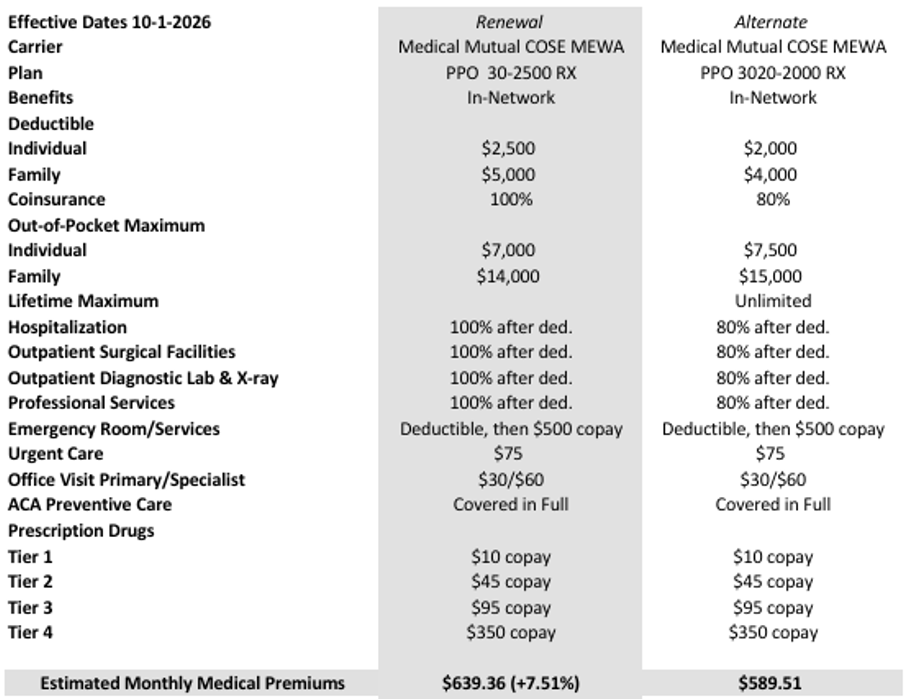
The first thing I do is pull the renewal apart and compare the benefits side by side.

I’m looking beyond the premium to understand what changed and whether those changes justify the increase.

Insert comparison table image here

Caption: An anonymized comparison showing how we evaluate renewal options before making any recommendation.

2. Look for the Least Disruptive Solution

I’m not trying to find the cheapest plan.

I’m trying to preserve as much of what employees already know and value as possible while bringing the renewal back under control.

Before considering another carrier, I’ll often evaluate whether modest adjustments to the current plan are enough to improve the renewal, such as:

  • A modest change in coinsurance.
  • A slightly higher deductible.
  • A different out-of-pocket maximum.
  • Another plan from the same carrier with similar benefits.

Sometimes a relatively small adjustment is enough to bring a renewal back into a range the employer is more comfortable accepting.

3. Ask the Bigger Question

Only after we’ve explored those possibilities do we ask:

Is it time to look beyond the current plan?

Sometimes the answer is yes.

Sometimes it isn’t.

That’s the point where we decide whether a broader market review or health insurance prescreen is worthwhile.

Every Renewal Starts a Conversation

No two employers are exactly alike.

The right answer depends on the business, the employees, and the goals of the employer.

That’s why I think of a renewal as the beginning of a conversation rather than the end of one.

Over the coming weeks, I’ll share a few anonymized renewal examples that show how this process works in practice.

At a Glance

  • Renewals deserve analysis before shopping.
  • We look for the least disruptive way to control costs.
  • Premium is only one part of the decision.
  • Structural changes can matter as much as plan changes.
  • Every employer’s situation is unique.

Frequently Asked Questions

Should I get quotes immediately after receiving a health insurance renewal?

Not necessarily. Before requesting quotes, it’s often helpful to understand exactly what changed and whether modest adjustments to the current plan could improve the renewal.

Does every renewal require changing insurance carriers?

No. In many cases, employers choose to remain with their current carrier after evaluating plan options that better balance premiums, benefits, and disruption.

When should a small business consider a health insurance prescreen?

A prescreen is often worthwhile when reasonable plan adjustments don’t produce an acceptable outcome or when an employer wants to evaluate broader market options before making a renewal decision.

About the Author

For more than three decades, Ted Stevenot has helped Ohio small businesses evaluate employee benefits as a partner at McCarthy Stevenot Agency, Inc.

He writes the Broker’s Desk series to share practical observations from real health insurance renewals and employee benefits decisions.

Protecting Our Client’s Client Privacy

Client names, identifying details, and certain facts have been modified or omitted to protect client confidentiality. The situations described reflect real-world experience, but no post is intended to identify a specific employer.

Looking for a deeper explanation of the renewal process? These guides provide additional context.

Related Resources

Disclaimer

Broker’s Desk articles are educational and based on real-world situations encountered in our practice. Client names and identifying details have been changed or omitted to protect confidentiality. Because every employer’s circumstances are unique, these articles should not be considered legal, tax, or insurance advice for any specific situation.